

The Fold Blog

Pilates for lower back injuries
Mat pilates is a low-impact form of exercise that focuses on strengthening and toning the core muscles of the body. It is a popular workout for individuals with lower back injuries, as it can help to improve flexibility, stability, and strength in the lower back. If you have a lower back injury, it's important to work with a qualified pilates instructor who can help you modify exercises to suit your needs and avoid further injury. A good instructor will be able to provide you with a personalized workout plan that takes into account any limitations or restrictions you may have. Mat Pilates is a popular exercise method that can be highly effective for individuals suffering from lower back injuries. The low-impact, controlled movements of Pilates can help to strengthen the muscles in the back and improve overall posture, leading to reduced pain and improved function. One of the key benefits of mat pilates for individuals with lower back injuries is that it can help to improve flexibility and mobility in the spine. By practicing pilates regularly, you can increase the range of motion in your lower back, which can help reduce stiffness and pain. Additionally, pilates can help to strengthen the muscles in your back, which can support the spine and improve posture. Another key benefits of Pilates for those with lower back injuries is its focus on proper alignment and control of the body. By paying careful attention to posture and form, Pilates can help to retrain the body to move in a more efficient and healthy manner, which can help to reduce strain on the lower back. Mat pilates can help to improve stability and balance in the lower back. By incorporating exercises that challenge your balance and stability, you can improve your body awareness and control, which can help to prevent future injuries. Another important aspect of Pilates is its emphasis on the core muscles, which play a crucial role in supporting the lower back. Through a series of exercises that target the abdominal and back muscles, Pilates can help to strengthen these key muscles, providing added support and stability to the lower back. A key principle of Pilates is the concept of "centering". This refers to the idea of bringing the body's center of gravity into alignment, which can help to improve posture and reduce strain on the lower back. By practicing Pilates exercises that focus on proper alignment and centering, individuals with lower back injuries can improve their overall body mechanics, leading to reduced pain and improved function. Mat pilates can also help to improve overall posture, which can have a positive impact on lower back pain. Poor posture can cause the muscles in the lower back to become strained and overworked, leading to pain and discomfort. By practicing pilates, you can learn to align your body properly, which can help to relieve tension in the lower back and improve your overall posture. In addition to the physical benefits of mat pilates for lower back injuries, it can also have a positive impact on mental well-being. Exercise, in general, has been shown to reduce stress and improve mood, and pilates is no exception. By practicing pilates regularly, you can learn to calm the mind and relax the body, which can help to relieve stress and anxiety and improve overall mental well-being. Mat pilates can be a beneficial form of exercise for individuals with lower back injuries. It can help to improve flexibility, stability, and strength in the lower back, and can be customized to suit individual needs and limitations. By incorporating mat pilates into your routine, you can take an active role in managing your lower back injury and improving your overall well-being. Need the perfect pilates mat to support your body? Try foldUP's Movement Mat - it's a foldable yoga mat that's extra thick and can be folded into sections to support your body where you need it the most.
Learn more
Benefits of yoga for back pain
Yoga is a centuries-old practice that involves a series of physical postures, breathing techniques, and meditation. It is a popular form of exercise that offers a wide range of physical and mental benefits, including relief from back pain. If you suffer from chronic back pain, you may find that traditional forms of exercise, such as running or weight lifting, can actually make your pain worse. Yoga, on the other hand, is a low-impact form of exercise that can help alleviate back pain and improve your overall well-being. One of the key benefits of yoga for back pain is that it helps to improve flexibility and mobility in the spine. By practicing yoga regularly, you can increase the range of motion in your spine, which can help reduce stiffness and pain. Additionally, yoga can help to strengthen the muscles in your back, which can help support the spine and improve posture. Yoga can also help to reduce stress and improve mental well-being, which can have a positive impact on chronic back pain. Stress and anxiety can cause the muscles in your back to tense up, which can lead to increased pain and discomfort. By practicing yoga, you can learn to calm the mind and relax the body, which can help to relieve tension and reduce pain. You'll want to invest in a good quality yoga mat. Having a good quality and extra thick yoga mat can really help support your back and your joints through your practice. foldUP's Movement Mat is 6mm thick and can be folded into sections to support the areas you need it the most. Practicing yoga can offer a wide range of benefits for individuals suffering from chronic back pain. It can help to improve flexibility and mobility in the spine, strengthen the muscles in the back, and reduce stress and anxiety. By incorporating yoga into your routine, you can take an active role in managing your back pain and improving your overall well-being.
Learn more
The best yoga mat for sweaty hands
The best yoga mat for sweaty hands is a personal choice, as everyone has different preferences and needs when it comes to their yoga practice. However, there are a few key factors to consider when choosing a yoga mat that will help prevent slipping and sliding during your practice. First and foremost, you want to choose a yoga mat that has a good grip. Look for mats that are made from materials that are known for their ability to provide a stable and non-slip surface. Some popular options include natural rubber, jute, and cotton. These materials are not only eco-friendly, but they also provide a good grip that will help prevent you from slipping and sliding during your practice. Another important factor to consider is the thickness of the yoga mat. A thicker mat will provide more cushioning and support, which can be especially helpful if you have joint issues or if you prefer a softer surface to practice on. However, keep in mind that a thicker mat may not provide as much grip as a thinner mat. Finally, you want to choose a yoga mat that is easy to clean and maintain. Sweaty hands can lead to a build-up of bacteria and germs on your yoga mat, so it's important to choose a mat that is easy to clean and maintain. Some mats come with a built-in antimicrobial layer that helps prevent the growth of bacteria and germs, while others are made from materials that are naturally resistant to bacteria and germs. In conclusion, the best yoga mat for sweaty hands is one that provides a good grip, is the right thickness for your needs, and is easy to clean and maintain. By considering these factors, you can choose a yoga mat that will help you stay stable and focused during your practice, no matter how much you sweat.
Learn more
Yoga for the body and mind
There are so many benefits to a consistent yoga practice, both for your physical and mental body. We all spend a little too much time sitting at a desk and scrolling on our phones, and this will certainly take its toll. Yoga doesn't have to look like a 60 minute strenuous workout, yoga can be done anywhere, anytime. We like to think of our yoga practice as little moments that can bring us back to the present. We've created 4 ways to practice yoga, that can be done today and will leave you feeling more grounded and present. 1. Limit your time on social media. We’re all guilty of spending a little too much time on our devices. Set yourself a goal to limit the amount of time you spend on your phone, and instead enjoy the time being present with your loved ones. I love switching my phone to flight mode - I can still take photos and capture the moments but I’m not distracted by text messages or notifications popping up, and I’m really able to give those around me the time they deserve.2. Move your body for at least 10-15 minutes a day. Find a form of movement that makes you feel good. I’ve learnt over time that less is more, and sometimes 10-15 minutes of movement is all your body needs. A brisk walk, a short yoga flow, or a quick Pilates burn are my go-tos on the days I don’t feel like moving. I always feel better for it both physically and mentally. It’s incredible how just 10 minutes of movement can make you feel.3. Spend time outside. This is a no-brainer for helping me feel grounded. I love to start my day with a walk outside, without my phone, and just start a little slower. If you feel like the holiday season is an energy zapper, and you are spending lots of time around people, start your day on your own to fill up your cup first. If you’re short on time, see how it feels to get up just 20 minutes earlier to squeeze in a bit of you time.4. Breath. If you feel like you've been running on adrenaline these past few weeks, chances are you haven't stopped to take a deep breath. The first thing that happens when you're stressed is you start to take shorter, more shallow breaths. Stop what you're doing and take 3 really long and deep breaths. Notice how you feel and take time to tune into your breath when you can. Notice how you feel after completing even just one of these suggestions. What does it feel like to move more mindfully, or breath more deeply? Enjoy!
Learn more
How to get started with functional movement
If you’re like most people, you probably think of functional movement as something that only elite athletes need to worry about. After all, if you’re not a professional athlete, what could you possibly have to gain by improving your functional movement? We're here to discuss the importance of functional movement for every body. Functional movement isn’t just for athletes; it’s for everyone. In fact, poor functional movement is one of the main reasons why so many people experience pain and injuries throughout their lives. By improving your functional movement, you can reduce or even eliminate these problems altogether. There are three main types of functional movement that beginners should focus on: 1. Mobility exercises – These exercises help improve your range of motion and flexibility. They can be performed anywhere, anytime, and don’t require any special equipment. Just grab your Movement Mat to support your body and you're ready to go. Some examples of mobility exercises include: Neck circles – Gently rotate your neck in a circular motion, clockwise and then counterclockwise. Shoulder rolls – Roll your shoulders up, down, and around in a circular motion. Hamstring stretch – Sit on the ground with your legs straight out in front of you. Reach for your toes and hold the stretch for 10-30 seconds. Hip flexor stretch – Kneel on the ground with one knee bent and the other leg extended behind you. Lean forward until you feel a stretch in the hip of the extended leg. Hold for 10-30 seconds. 2. Strength exercises – These exercises help improve your muscle strength and endurance. They can also be performed anywhere, anytime, but you will need some basic equipment like weights or a resistance band. Some examples of strength exercises: Squats – Standing with your feet shoulder-width apart, squat down until your thighs are parallel to the ground. Hold for 10-30 seconds, then stand back up. Lunges – Standing with your feet shoulder-width apart, step one foot forward and squat down until that thigh is parallel to the ground. Hold for 10-30 seconds, then switch legs and repeat. Chest press – Lie on your back on the floor with a weight in each hand. Extend your arms straight up towards the ceiling, then lower them back down to the starting position. Bicep curl – Have one weight in each hand and let them hang at your sides with your palms facing forward. Bend your elbows and curl the weights up towards your shoulders. 3. Balance exercises – These exercises help improve your balance and coordination. They can be performed anywhere, but a stability ball or a balance beam may be helpful to increase the challenge. Some examples of balance exercises: Single-leg stand – Stand on one leg and hold for 10-30 seconds. Repeat with the other leg. Seated balance – Sit on the ground with your legs straight out in front of you. Hold for 10-30 seconds. Standing balance – Stand with your feet together and your eyes closed. Hold for 10-30 seconds. Each of these types of functional movement has its own benefits, and by incorporating all three into your routine, you’ll be well on your way to improved health and fitness.
Learn more
Office Workers Rejoice! These Stretches Will alleviate Your Lower Back Pain
If you're reading this, it's probably because you spend too much time sitting at a desk. And if you spend too much time sitting at a desk, you're probably all too familiar with the lower back pain that comes along with it. Luckily, there are a few easy stretches that you can do right at your desk to relieve some of that tension. Keep reading for the best stretches for sore lower backs!1. The Seated TwistStart by sitting up straight in your chair with your feet flat on the ground. Take a deep breath in, and as you exhale, twist your torso to the right, placing your left hand on the back of the chair for support. You should feel a gentle stretch in your lower back and hips. Hold for 20-30 seconds, then repeat on the other side.2. The Cat-Cow StretchStart on all fours, aligning your wrists beneath your shoulders and your knees beneath your hips. As you inhale, drop your stomach towards the floor and lift your chin and chest towards the ceiling, creating an arch in your spine. This is the "cow" position. As you exhale, round your spine towards the ceiling, tucking your chin towards your chest and drawing your belly button up towards your spine—this is the "cat" position. Repeat 5-10 times, moving slowly and smoothly with each breath.3. Pigeon Pose If you spend a lot of time hunched over your keyboard, this stretch is for you. Pigeon pose helps to stretch out the outer hips and glutes, which can become tight from sitting. To do this stretch, start in downward facing dog. From there, bring your right knee forward to meet your right hand. Lower your left leg down to the ground so that your left foot is pointing back behind you. You should feel a nice stretch in your right hip and glute. Hold for 30 seconds and then repeat on the other side.If lower back pain is something that plagues you on a regular basis—especially if you sit at a desk all day long—give these stretches a try! They only take a few minutes but can make a world of difference when it comes to alleviating tension and pain in the lower back region. Trust us, your sore lower back will thank you later!
Learn more
How to choose the best yoga mat for you
When it comes to choosing the best yoga mat for your movement needs, there are a few things you might want to consider: Are you someone who likes to practice at home? Do you like to take your mat to the studio with you? Are you looking for a lightweight and compact mat? Do you want a mat that travels easily? Are you looking for a thick and supportive mat? What eco-friendly alternatives are available? If movement is an important part of your lifestyle, we recommend investing in a good quality mat that will stand the test of time. Here are four tips to help you choose the best yoga mat for you: 1. If you want to be able to easily take your mat on the go, you'll want to choose a portable and compact option that is easy to transport and store. foldUP's Movement Mat folds into a square and can easily fit in the Movement Bag, or even a tote bag. It weighs 1.2kg making it more than half the weight off many other mats on the market. 2. If you're someone who needs a bit of extra cushioning to support your joints, you'll want to consider investing in a thicker yoga mat. A thicker yoga mat will provide the right level of support for your practice, ensuring that you're able to maintain proper alignment and avoid injury. foldUP's Movement Mat is 6mm thick and can be folded in various ways to add even more support. 3. Another factor to consider when choosing a yoga mat is its eco-friendly credentials. Many yoga mats on the market contain harsh chemicals, heavy metals and PVC - a toxic plastic that is harmful to both humans and the environment. If eco-friendly options are important to you, there are so many alternatives! foldUP's movement mat is made from 100% top grade TPE material - containing no harsh chemicals and is much better for the environment! 4. Consider is how much support and comfort you need for your practice. A good yoga mat should provide the right level of support for your practice, ensuring that you're able to maintain proper alignment and avoid injury. If you thought it wasn't possible to have all of these requirements in a yoga mat, think again. The Movement Mat was designed as a solution to the problem - a lightweight, compact, supportive and flexible Movement Mat that will support your body in your practice. We're revolutionising a more comfortable and convenient way to move.
Learn more
The Perks of a Thicker Yoga Mat
If you've been to a yoga class, you've probably noticed that not all yoga mats are created equal. Most mats on the market are somewhere between 3-5mm thick which can feel quite uncomfortable when practicing on a hard surface. While there may not be a consensus on which type of mat is best, we're here to discuss the benefits of a thicker yoga mat and how this can support your movement rituals. Here's why having a thicker yoga mat is better for your joints. Less Pressure on Your Joints If you have sensitive joints or are prone to injuries, a thicker yoga mat is definitely the way to go. Thicker mats provide more cushioning, which means less pressure on your joints when you're in any weight-bearing poses. Not only will this help you avoid injury, but it can also make your practice more comfortable - we want you to spend less time thinking about your uncomfortable joints and more time focusing on your practice. Support for your knees We've all felt the wooden floor underneath our knees when in table top position - and we're here for the solution. If you're someone who struggles with knee pain during your yoga practice, a thicker mat can be a real lifesaver. Thicker mats provide more support for your knees, which can help to prevent pain and discomfort during and after class. So if you're looking for a little extra knee support, foldUP's 6mm Movement Mat the way to go - simply fold one section of your mat and you've got double the support. Watch this video here to see a few ways you can use your mat to support your movement practice. Why choose a foldable yoga mat? If you're looking for a yoga mat that provides the best of both worlds, consider a foldable yoga mat. These mats are thicker than your average yoga mat, but they can be folded up for easy transport to and from the studio, can be easily stored at home, provides more support for your body AND you can take it in your hand luggage. Have we sold you yet? foldUP's Movement Mat is the perfect option for people who like to practice at home or on the go. A foldable yoga mat is also a great choice for beginners who are just starting out. The extra thickness makes these mats more forgiving, which can help you learn the basics without getting frustrated. Plus, when you're ready to take your practice to the next level, you can simply unfold your mat and go! No matter what type of yoga you practice, having a thicker yoga mat can provide numerous benefits. From cushioning your joints to absorbing sweat, a thicker mat will help you stay safe and comfortable during your movement practice. foldUP's Movement Mat was made for all types of movement - take it with you on the go or neatly store this mat at home - you won't be disappointed.
Learn more
A commitment to sustainability - products that are made to last
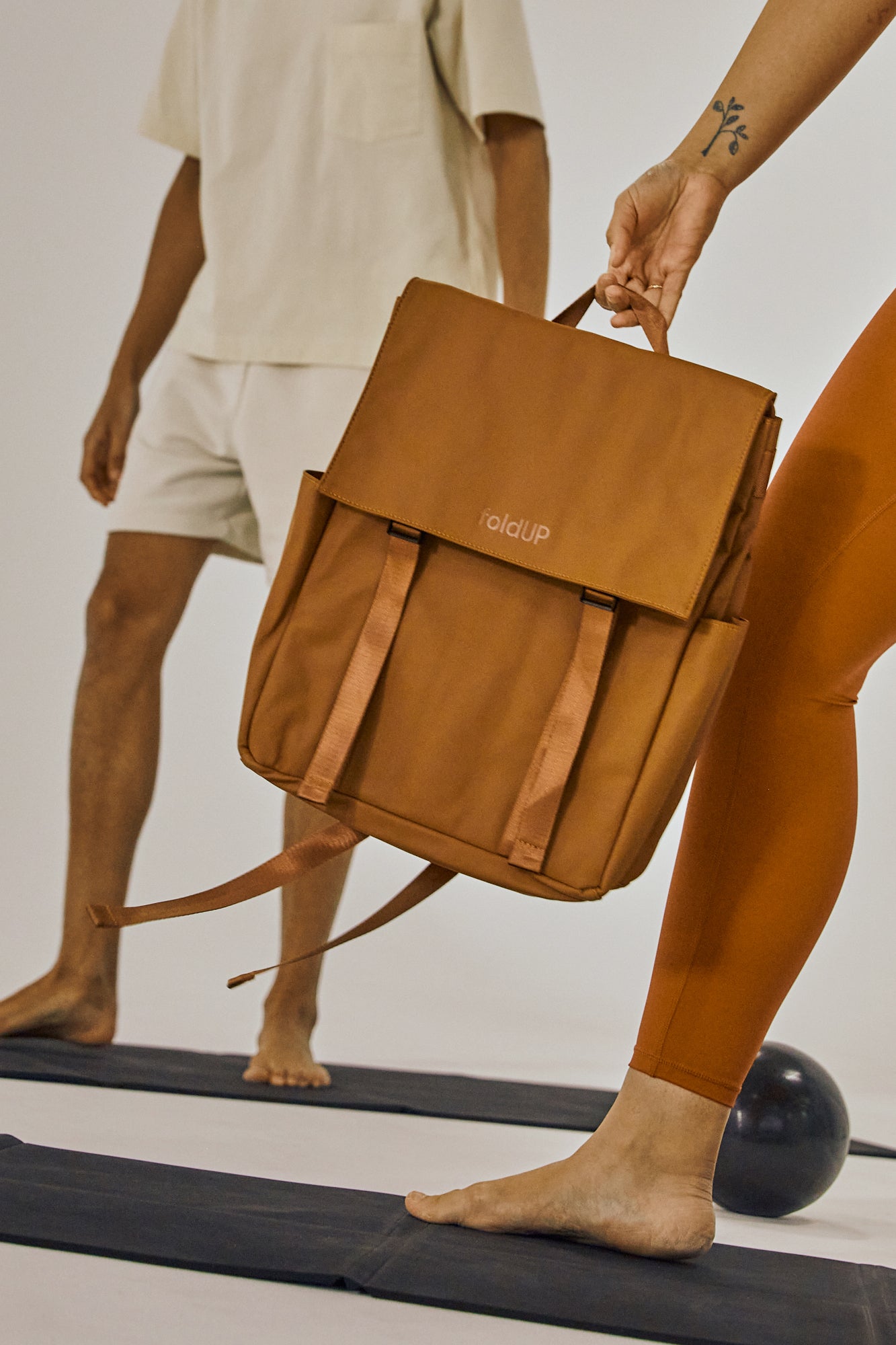
With more products than ever on the market, it was important to us to create products that last. We are living in a fast paced world and consume more products than we know what to do with. We have designed and created these products to last - made from good quality, eco-friendly materials so you can really enjoy these products we have worked to hard to create. As a yoga teacher and lover of all kinds of movement, I have tried and tested my fair share of yoga mats. I've felt that most are heavy, bulky, inconvenient and just don't provide the support we need for our joints. You might be thinking 'why did you create a foldable yoga mat?' For us, it was important for a few reasons: 1. We want to be able to take our yoga mat away with us - think of this as the perfect travel yoga mat. As is stands, travel yoga mats are thin and unsupportive. 2. Traditional yoga mats are made from toxic materials. We've made our Movement Mat from 100% top grade TPE fabric, without the heavy metals, harsh chemicals or PVC, and ensured our mat is recyclable and biodegradable. 3. The ability to fold the mat into sections to provide your body with the support that it needs has been a game changer for our movement practice. Whether you like high impact training or you're using your mat for a good end of day stretch, this foldable yoga mat is your go to. 4. We wanted something lightweight, compact and portable. We've created an extra thick 6mm multipurpose mat that fits perfectly into your carry on, or our Movement Bag. Did we mention our mat is lightweight and weighs only 1.2kg? Now the Movement Mat might have been our initial idea, but we've created a pretty stylish backpack to go with. Your Movement Bag is made from 100% vegan leather and has a 100% cotton interior. You can use this as your gym bag, your travel bag, your nappy bag, you name it. It's sleek, stylish and fits all your daily necessities. Shop both products and save $40.
Learn more